A Day and a Night on the Bietschhorn
W. A. B. Coolidge, Alpine Journal Vol 6, (1872–74): p124.
Although attributed to her nephew, the account is actually by his aunt Marguerite (Meta) Breevort: in 1872 the AJ didn’t accept articles from women. Leslie Stephen set a high standard, but he wasn’t the only one to write lively climbing stories with self-deprecating humour and slightly patronising social commentary…
FIVE years ago, as we stood on the summit of the Nesthorn, we had gazed both admiringly and longingly at the Bietschhorn, whose magnificent outline and exquisitely-beautiful details form one of the most prominent features of that perfect view. At once we expressed a wish to attempt it, and were not a little disappointed at Almer's most discouraging reply that it was too schwer for us. Though only too right, as we have since found out, he did not stick long to his opinion; so that for several years we had put down the Bietschhorn on our list of summer projects without ever having actually attacked it. Nor when we left Zermatt on the morning of the 18th of September 1871, did there appear to be much hope of our then accomplishing it. The weather seemed to have fairly gone to pieces. Dark and lowering from the first, we had not reached Randa before the rain began to come down in a gradually-increasing deliberate way, which gave no hope of mending for that day at least. So, as we jolted along in our rattling little conveyance, seeking for as much shelter as we could get from a huge red cotton umbrella, borrowed for us by the driver from some chalet on the road, we began recasting our plans to suit altered circumstances. As we were within easy reach of our friends at the Bel-Alp, it was only turning towards Brieg instead of Gampel, on our arrival at Visp.
I cannot say that we felt very despondent at the prospect of rest and ease which this change of plans implied, for we had been working very hard indeed for the past fortnight. Almer was equally inclined to view matters cheerfully, as he would now be able to visit a great cattle-fair at Meyringen, where he hoped to have an opportunity of buying ‘the last sweet thing’ in the way of cows and pigs—a prospect seemingly as charming to him as a day’s shopping in Paris would be to most ladies.
‘And the Bietschhorn will be for next year;’ and it seemed to float away dreamily with all the other ‘unvisited Yarrows’ of our experience. At St. Nicolas we had to give up our little carriage, and being burdened with a tent and more baggage than the two Almers could conveniently carry, we took as porter to Visp the youngest of the three brothers Knubel, Peter Joseph by name, with whom we had only parted a day or two before. But as we journeyed on the weather began to show most decided symptoms of improvement. The rain ceased, the low hanging mist, which had hitherto enveloped the whole valley, as with a veil, gradually dispersed, the clouds broke away, and the sun shining out in the most brilliant mood imaginable, soon lent life, colour, and cheerfulness to the whole landscape. This was irresistible. We all agreed that it would be trifling with Fortune to slight such manifest tokens of her favour; and giving up all thoughts of inglorious ease and fat cattle, the Bietschhorn again became our motive and hope. We were to push on to Ried that night, but the usual delays at Visp—a place one is always glad to leave, and where, notwithstanding, one is always detained in the most unaccountable manner—made it quite 3 o’clock when we at last drove off, and 4.20 p.m. by the time we arrived at Gampel, at the entrance of the Lötsch-thal, where another delay occurred in procuring a horse for the lady of the party. At Gampel we engaged a man called Peter Siegen, who had taken part in M. de Fellenberg’s ascent of the Bietschhorn, to accompany us. The sun had set by the time we had finished the endless zigzags on the first part of our road, and darkness overtook us as we left the deserted little village, or rather group of buildings, once used for smelting the silver ore brought down from the mines above. Not a pleasant road this to traverse in the dark on horseback, thought the unfortunate equestrian. The horse apparently shared the general aversion to water of most natives of the Rhone valley, and shied and backed whenever he was made to step into one of the many streamlets and small torrents hurrying across the path. Nor was it reassuring to hear the men caution one another, lest the poor animal should step between the disjointed planks of the crazy little bridges which occurred now and then. Add to this the frightful state of the road—a mass of loose rolling stones made slippery by the morning’s ruin, and by the streams running over them—which caused frequent and alarming stumbles and slips of men and horse. Besides all this, one could not but remember that a fall might possibly end in the wild torrent of the Lonza, which we heard rushing along ever so many feet below the precipitous sides of the road, over which we were travelling in what would have been complete darkness but for the glimmer of a few faint stars. It was a rapturous sight when the still far-distant light of Kippel suddenly appeared. Some of us were for seeking the curé’s hospitality for the night; but more magnanimous counsels prevailing, we jogged past the friendly light towards Ried, where we were very glad to arrive at a quarter to nine. The host of the little inn received us most hospitably—rather too hospitably indeed—for so anxious was he to get us a good supper, that we all but died of hunger before it was ready, although we assured him that in our famished condition it mattered very little what he set on the table. Most unheard-of delicacies were at length spread out before us—brains, livers, and the interiors of all sorts of wild animals, culminating in an entire squirrel! which looked in the dish so very like an obese snake, that, the edge of our hunger having by this time been taken off, we could not make up our minds to taste it, although no doubt it was capital.
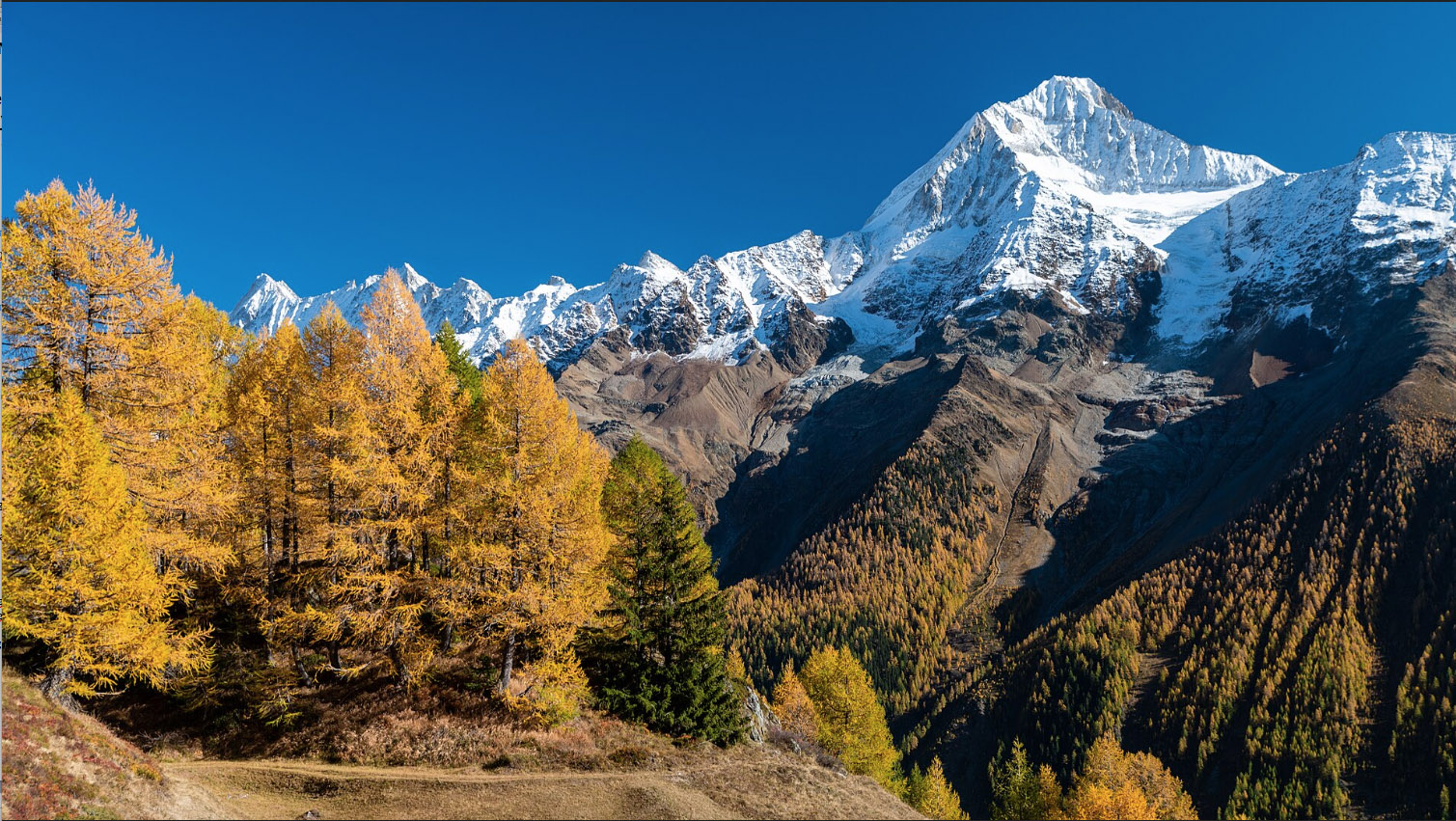
The north-west side of the Beitschhorn from the Lötschental High-level Route by Christoph Strässler (Wikipedia DE). The Nest Glacier is down to right of the summit: North ridge (ascent route) runs towards the camera, West ridge (descent route) on right skyline.
Next morning was beautiful, and as we gazed upwards at our peak, which just showed its summit above the darkly-wooded hills which wall in the valley, we longed to be off at once ; but one of our party being a slow walker, and the days already very short, we knew it would be impossible to reach the top at any decent hour unless we started from some higher point than the inn. The first day’s walk would necessarily be a short one, as we could go no farther than the base of the mountain, and there pass the night in a tent, setting off early the next morning.
As there was no use in leaving Ried before noon, we amused ourselves with looking over the ‘livre des voyageurs’ and in trying to make out, as well as we could with an imperfect knowledge of German, the account given in the Swiss ‘Jahrbuch’ for 1869–70 by M. de Fellenberg of his ascent of our mountain. Whether it was that we did not arrive at the true meaning of the text, or that we were in a very reckless and absurd frame of mind, I know not; but there were parts of the narrative which made us shout with laughter, although I think they were intended to excite very different feelings in the reader. From it we gathered that at one time the luckless narrator and his companions were obliged to descend an arête literally à califourchon [one leg on each side]. Instead of compassionating their most uncomfortable position, a spirit of madness seized us, and we laughed till we were tired as we imagined them. But ‘rira bien qui rira le dernier’ proved a true proverb in our case, for the time came when we fully realized what the difficulties of that same ridge were, and when they no longer affected our risible faculties. Meanwhile, unconscious of our approaching doom, we laughed, feeling quite positive that we should never ascend or descend in that fashion.
Our host looked as if he had once seen a ghost, and had never quite recovered from his fright. He really was so devoted to our comfort that we felt quite grateful to him, until he informed us that he made no money at all by his inn, and kept it from purely philanthropic motives. After that, we considered him as only following a strong natural vocation for hospitality—in fact, a sort of lay monk of the order of St. Bernard on a mission in the wilderness of the Lötschthal. He appeared to think that we must feel hungry every half-hour, and was constantly coming in to propose some new kind of refreshment, as well as to report progress concerning the provisions being got ready below; and thus let us into the secret of the ‘wildness,’ if one may so call it, of his larder. It was the result of the hunting propensities of a very profitable lodger he was entertaining for the summer, who spent all his time in the woods shooting, accompanied by a curious dumb dog, whose acquaintance we also made. This dog could not bark, and wore a bell that his master might know his whereabouts. As our dog Tschingel, who was with us, came originally from the Lötschthal, and very much resembled our new friend (except in his dumbness), we tried to persuade him to fraternise with one who was probably some near connection ; but Tschingel indignantly repudiated the theory, and showed the most worldly-wise contempt for his poor relation, not suffering him to enter the dining-room. We were also much interested, and indulged in sundry speculations as to the origin and history of a very ancient pike and part of a suit of armour, both of gigantic size, which our host told us had been found in a neighbouring village, while clearing away the ruins of some cottages which had been burnt down. A dagger, found at the same time, and of equally wonderful proportions, he had given, he said, to M. de Fellenberg.
At noon we set off—a funny-looking party. Christian and Ulrich Almer carried the ropes and provisions, Knubel the tent, Siegen some blankets, a Ried porter a hotte full of nondescript articles for the cuisine; and, lastly, an Oberlander, who had asked Almer to employ him, was loaded with a huge bundle of straw, which made him look like a walking haystack, and which was intended for those who were to sleep outside the tent. Nothing could be more beautiful in its way than was our walk to the camping-place. After crossing the little stream in front of the inn, and going through some meadows, we entered the most solemn old pine-woods. The brilliant sunshine which streamed here and there through their sombre branches dispelled all gloom, but could not banish the feeling of quietness and mystery peculiar to them. We were sorry to leave their shade for steep, stony grass-slopes. The men here began to gather firewood as they strolled along. We climbed slowly, looking back continually at the various new peaks now showing themselves on the opposite side of the valley. Among these the Breithorn was conspicuous, and the broad, level summit of the Petersgrat became plainer every moment. Siegen and the Ried porter, who was his servant, soon showed symptoms of fatigue, and were continually suggesting that it was time to set up the tent, as, if we went too far, it might be inconvenient to get water. Almer lent a deaf ear for a long while to all their remarks, until we had got on to the lower end of the great rocky mass which divides the Nest and Birch glaciers, and culminates in a point marked 3,320 on the Federal map. Here he proposed that we should halt, whilst he pushed on alone to reconnoitre. Away he went, climbing up some very steep rocks in his usual rapid manner, and was soon out of sight. This seemed a favourable opportunity for examining Siegen with more attention than we could give him whilst walking. And he really was worth inspection, somewhat resembling one of Salvator Rosa’s brigands, but still more the conventional stage representation of Mephistopheles. His dark eyes, heavy eyebrows, long black hair, and still longer moustaches, with that peculiar twist in them remarkable in those of the chief personage in ‘Faust,’ were most picturesquely set off by a slouched hat, ornamented with a long trailing bunch of cock’s feathers. It was impossible not to attempt a sketch of him, and to this he lent himself very complacently, recounting the while various details of M. de Fellenberg’s ascent, and dwelling especially on the really amazing quantity of wine he had helped to consume on that occasion. We were much edified, when, as he pulled out his handkerchief, two or three sets of beads came out with it, which, he laughingly said, were none too many for the Bietschhorn.
In about an hour Almer returned, having found exactly the place for our camp; and, much to Siegen’s regret, we all set off to reach it, and arrived there at 4 P.M., the whole ascent from Ried, with numerous halts, having only occupied 35 hrs. The two porters were sent back somewhat later. Our position was a commanding one. Looking back towards Ried (which we could not actually see), the Nest glacier was on our left, far below us, the rocks on which we were standing rising very precipitously above it. On our right were wild savage cliffs, which rose higher and higher behind us, until, far above, we could see the sharp summit of our peak looking down upon them. It seemed almost to beckon us on to attempt it, as it shone out gloriously in the light of the setting sun, the rays of which made the snowy range on the opposite side of the valley glow with new beauty. In the midst of this splendid scene, and after a much-enjoyed supper, we retired to rest, full of hope for the morrow, though somewhat chilled by the cold September night air.
The night proved sharp and frosty, and we did not start the next morning till after 5.30 a.m., when the sun had gained a little strength. The party consisted of a lady, myself, the two Almers, Knubel, and Siegen. It was thought best to leave Tschingel, our faithful dog, behind in the tent, not because of any supposed incapacity on his part, as he was perhaps the most accomplished mountaineer of the party, but because Almer feared that he would throw down stones from above upon us, as he always chooses his own route on the ascent and insists upon leading.
We began at once to climb the steep rocks immediately behind our camp, and at 6.50 a.m. got on to the Nest glacier, near a large cave or hole formed by the rocks overhanging the glacier at their point of junction, on the side of the rocky mass mentioned above. With this cave, which we scarcely noticed at the time, we afterwards became rather intimately acquainted. Mounting the glacier gradually, meeting with a few crevasses, we soon reached the centre of the semicircle plainly visible on the map, and at the very foot of the mountain, which we now saw for the first time from tip to toe, being even able to distinguish one of the stone men on the summit.
It may not be out of place here to give a slight sketch of the peak of the Bietschhorn. It is formed by the union of three principal arêtes, running roughly towards the north, south, and west. The summit is a long and extremely shattered ridge, out of which rise three rocky towers, nearly equal in height. The southern arête falls away precipitously towards the valley of the Rhone, but the two others are more practicable. Mr. Leslie Stephen, when he made the first ascent of the mountain, in 1859, seems to have followed the northern arête on his ascent and descent. When the mountain was climbed for the second time, in 1867, by M. de Fellenberg, the ascent was effected, I believe, by the western, and the descent by the northern arête. Several attempts to ascend the peak failed, and ours was the next successful ascent. As will be seen, we exactly reversed M. de Fellenberg’s route.
It was after 7.30 a.m. when we halted for breakfast in the centre of the semicircle mentioned above, after which repast we parted with Siegen, who showed no unwillingness to return to the tent, Knubel having petitioned to be allowed to go to the top, and Almer thinking that as Ulrich was also with us we could very well dispense with Mephistopheles. Turning to the left, our party of five marched over the glacier to the base of the northern arête, which we began slowly to ascend. The rocks were very rotten, and fell down at the slightest touch, so that we had to be very cautious in our movements. We gained the crest of the arête, after a good deal of trouble, at 10.30 A.M., and followed it henceforth, with slight deviations, to the summit. It very soon changed into a very sharp snow-ridge, which had a threatening corniche overhanging the Jägi-firn of the Federal map.* The weather up to this time had been perfect, and whenever we could afford the time, we had been only too glad to pause and gaze at the magnificent prospect which began to unfold itself before us. But now a change came over the fair scene. A strong icy wind began to whistle about our cars, and rising clouds to surround us. The ridge along which we were cautiously stepping was already quite difficult enough, without this most unpleasant companion, and now became utterly impracticable. Abandoning it, therefore, for a while, we crept along the projecting rocks just below it, overhanging the Nest glacier, until it became somewhat wider, and we were able once more to return to it. But the snow here turned into ice, and many a weary step had to be cut before the fir»t stone man was reached at 12.30 P.M. The wind was still howling and nipping our noses, ears, and fingers pitilessly ; but, although there was now no hope of a view, we could not give up our summit. It was with difficulty that we made our way along the shattered ridge, trying, whenever we could, to keep below it. At length we reached the top at 1.10 P.M., the ascent having occupied 7 1/2 hrs., including all halts. We could see nothing beyond the rocks immediately around us, as we were enveloped in clouds, which the wind drove about tumultuously. But, although we regretted the magnificent prospect from the top, we were struck with the grandeur of what we could see—jagged rocks, splintered into every conceivable shape, piled up or strewn out in fantastic confusion. The drifting clouds also enabled us occasionally to form some idea of the startling precipices on all sides.
---
This point on the N. ridge was gained in 1866 by an English party from the Baltschieder Joch without serious difficulty ; but, owing to the retreat of the ice, this mode of approach to the mountain is said to have become difficult.
---
After a very slender and hurried repast, we turned to descend at 1.30 p.m., leaving our names in a bottle, carefully placed in the cairn. It was shortly after that a startling sight greeted us. The sun was glaring through the clouds, like a smouldering ball of fire. Suddenly we perceived a rainbow around us, and in the space between it and the sun our shadows were distinctly projected. It was almost unearthly to see these figures of gigantic projections moving as we moved.
We had now got back to the first stone man, and the clouds were becoming more broken every moment, so that there was a chance of our being seen in the valley. We therefore tied an old red handkerchief, which our host at Ried had asked us to use as a flag, to a stick, which was planted in the cairn, and was in a few minutes distinctly seen at Ried and at Kippel. We had no time to spare, and I rather believe the unexpressed wish of each of us was to get safely down again.
According to our original plan, we were to have descended direct to Raron, between Turtmann and Visp in the Rhone valley, at the opening of the Bietsch Thal—a route which some of us still think would have been the beat to adopt. Siegen, however, had so opposed it, that Almer had given it up before starting. We then determined to return the same way by which we had ascended. That way, however, had proved so dangerous towards the top, that Almer, with his usual prudence, altered our course. The upper part of the western arête being impracticable, he therefore led us down the great rock couloir, which opens out near the first cairn, and is well shown on the Federal map, being the space between the western arête and a spur of the southern. It was very steep, and the rocks, as everywhere else on this mountain, were of the most treacherous and unstable description, with no fixed principles to speak of. Almer meant, after descending this couloir for some distance, to mount to the right, in order to gain the crest of the arête, and to descend by the northern face to the Nest glacier—an excellent plan, had it not proved impracticable, owing to the many little ridges which shot out from the main ridge, and had every one to be crossed to gain the crest at a practicable point. At first we were very cheerful about it, expecting every one of these contradictory obstacles to be the last, but no sooner had we surmounted one than another cropped up before our disappointed eyes, and we began to lose patience. It would have been bearable, of course, however fatiguing, had we had any time to spare, but the light was fast fading, and, hurry as much as we could, we felt that night was approaching without any sign of a deliverance. So here we were, we who had felt so confident that we should never follow M. de Fellenberg's route, descending the very way he went up! And such rocks as they were! In the morning there had been some pretence at cohesion, owing to the night's frost, but now they had only too completely recovered their independence. They rolled down if one did but look at them. One immense fragment suddenly broke loose from a ledge which we had just descended, and falling on the rope between Almer, who was leading, and his immediate follower, dragged them both off their feet. They went rolling over and over, pulling down Ulrich, who came next, so that the three executed several prodigious somersaults before they were stopped by the last two of the party. The rope was found to be almost cut through where the boulder had struck it. A second occurrence of the kind, only a little less alarming, followed soon after; and what with Almer’s continual Geben sie acht,’
‘Dieses ist nicht fest,’ ‘Dieses ist ganz locker,’ and the continual rattling of stones about us, we became quite bewildered, and began at times to fancy that the whole mountain was coming down about our ears like a card-house. The twilight was fading away when we crossed the last little ridge, and at length set foot on the arête at its extreme western end. The moon had risen, but our old enemy, the wind, which had never ceased to blow, drove the clouds over her face, only allowing us occasional faint glimmers of light as we stumbled along, with many a fall on the cruel hard rocks, which, touch them never so lightly with foot or hand, set off at once with an avalanche of smaller stones in their wake. At length, bruised, weary, and sleepy, we reached the snow-field forming the summit-level of the Bietsch joch at 8.20 P.M., after a most painful descent of 6 1/4 hrs., the like of which we had never experienced, and hope never to experience again. The wind had now completely buried the moon in a bank of clouds, and the only light we had was that of a faintly-twinkling star or two. This mattered little so long as we were on the snow, through which we plunged rapidly, keeping to the right, until in 25 minutes we arrived at the exact spot where we had breakfasted in the morning. We knew this, because we here found a precious little barrel of wine, left buried in the snow, the recovery of which we had been for some time anticipating, as we had had nothing to drink since quitting the summit.
After this our difficulties began again. The glacier which still lay between us and the rocky mass, on the lower part of which stood our tent (our tent!), which had become to us the very embodiment of home comforts and safety, had been traversed without much difficulty in the morning, but to descend it in almost total darkness was a very different thing.
We groped along after Almer, who guided himself in a wonderful manner, occasionally even recovering for a few minutes our morning’s track by feeling with his hands for the steps cut in the ice, literally going à tâtons ! [by feeling around] Whenever we came to a crevasse, Ulrich sat down, and held his father by the rope, that he might creep over to find a safe way, and then direct us how to follow him. It was of course impossible, even with his consummate skill, to make rapid progress, and indeed we could not tell that we were not going backward instead of forward. We lost all hope of getting off the glacier for the night, but it was so bitterly cold that Almer would not allow us to make any halt, fearing lest we should freeze. A pleasant prospect this, of creeping almost on all fours about a glacier, with the wind whistling around us in the most derisive manner ! Now and then the men would speak to one another, and in the midst of the incomprehensible patois gibberish which they always adopt on trying occasions, we could hear the word ‘loch,’ [hole] and remembered a cave at the edge of the glacier which we had passed in the morning. It seemed so utterly improbable that we should ever find it again, that we gave no thought to the subject. What, then, was our delight when Almer exclaimed (this time in comprehensible German) that he felt sure that we were near that cave. Untying himself, he went off to reconnoitre, and joyfully called out to us to follow his track, as he had found it. It showed how closely he must, on the whole, have kept to the straight road, that in spite of occasional wanderings, we actually came out at the very place where we had taken to the ice in the morning. It was entirely due to his marvellous skill and sagacity that we did not spend the night on the ice. It was now a few minutes past 11 p.m., as we found out by striking one of a few precious matches which we had brought. Our tent was not very far off, but we were too thoroughly tired out to think of any more scrambling down the rocks which lay between us and it. So we thankfully descended one by one into the cave, which was large enough to contain us all, though not the most comfortable of places. However, we were only too glad of the shelter which it afforded us from the cold wind which howled outside, and too delighted to be off the ice and able to sit down to complain of anything. We had no more provisions, not having expected to be out so long, so that the satisfaction of eating was denied to us. We still had a very little wine, but that little was in a spiteful cask, out of which it was very difficult for an unpractised person to drink, and pouring it out into a leather cup in the dark was altogether too wasteful a process. Matches were now and then struck to find out the time. In spite of cold, hunger, and discomfort, we would drop off to sleep for a few minutes; but whenever a dead silence showed this to be the case, Almer would jump up and begin jodelling in the most aggravating manner, or else he would circulate the hateful little cask, addressing us in the liveliest manner, and thus to our disgust effectually rousing us up from our slumbers, which the cold rendered very dangerous.
Before daylight the wind ceased and snow began to fall. We were not able to leave the hospitable hole till nearly 5 A.M., after a stay of 6 hrs. We then followed our previous day’s route down the rocks, amid the falling snow, and regained the tent at 6.30 A.M. Siegen came to meet us with a bottle of champagne, provided by our philanthropic host, for which we heartily blessed him. The thoughtful man had sent up two porters to the tent, to find out what had become of us; and seeing us afar, they lit a great fire, the very sight of which was cheering on that wintry-looking morning. Tschingel, who had threatened to devour poor Siegen when he first tried to enter the tent on his return the day before, and was only pacified by the most abject advances from him, gave us an uproarious welcome. The kettle soon boiled, and we had some hot tea and coffee, after which we took a good rest in the tent, and descended to Ried in rain later on in the day. Our host received us with the choicest hospitality iu his power— a dish of brains for dinner.
Thus ended an adventure which was not far from having a serious end, since, in all probability, had we spent the night on the ice, this paper would never have been written.
By the time this was published in the Alpine Journal, nephew Willy had taken over from Leslie Stephen as its editor. Under his control, the journal would, a few years later, start accepting articles from lady mountaineers. They wouldn’t be able to join the Club itself until 1975—although, bizarrely, Tschingel the dog was accepted as an honorary member after her climb on Monte Rosa in 1869.
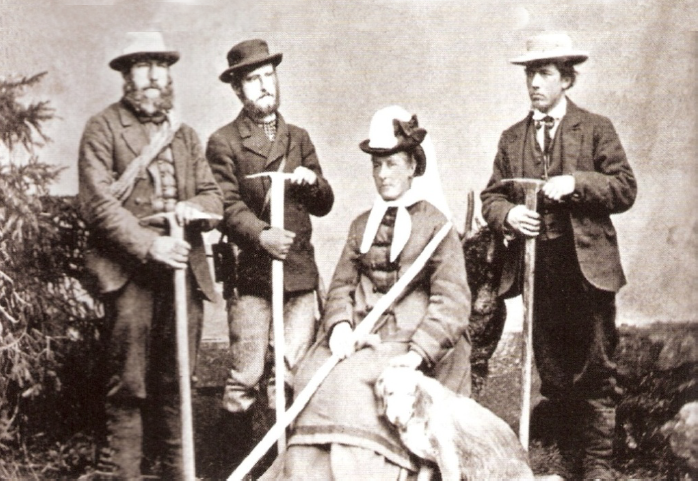
Christian and Ulrich Almer, Meta Brevoort, Tschingel, and William Coolidge